


Veritas Veteos Volume
Substack can make us lose touch with our work as a holistic, evolving pathway as opposed to a collection of ranked things. This is a series of observations on friends’ journeys and my own, as opposed to objective advice.
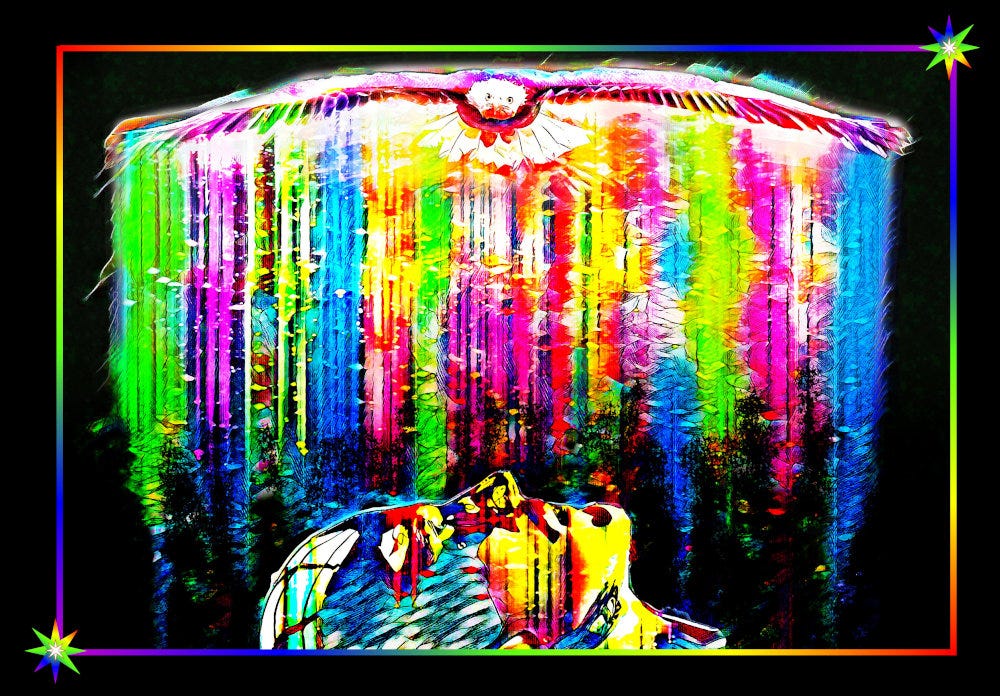
(Artwork entitled Vision Tunnel)
Algorithm or Ego-Rhythm?
There are many articles on the correct publishing schedule to maximise your exposure and ‘engage your audience’ on Substack. I lack the expertise to either confirm or refute the first part of the claim. The second I have some issue with, I don’t claim to know every reader or have statistical insight, but I am one myself and I choose between my favourite authors depending on my needs at the moment - my mood, an idea I recently had, or something I read that reminded me of them. The human soul does have rhythms, but they are more musical and complex than a system data feed. I firmly believe that successful posting schedules are firmly based on the first criteria.
Still, if the publication process must work to its schedule, our minds have no such obligations. This is where I come to my keystone idea in this discussion - we must take OUR time. We may move either faster or slower than the “two large pieces per week” Substack guideline or (as I do) vary between the two at different periods, but what is important is that we honour the pace that truly drives us. Now, even in this care is required for the mind is often a contradictory creature, and we may be writing from a point of comparison to peers or because it feels too lazy not to be writing, conversely, we may be holding back as we feel our writing to be unworthy. What we must listen for, obey, or wait upon is that deep need to express an idea, an emotion or a fully fledged story - that unmistakable call of something that feels as true, irresistible, and omnipresent as wind upon our skin. Incidentally your natural rhythm may be perfectly in sync with the Substack algorithm, what is important is that you find and follow that rhythm, and do not let anyone else (least of all me) tell you what that rhythm is.
Writer’s Block or Clarke’s Monolith?
When speaking about rhythms and publishing frequency, the subject of writer’s block inevitably raises its head. A quick explanation of the subtitle - In Arthur C Clarke’s novel 2001 A Space Odyssey an alien race has distributed evolution enhancement devices shaped like black monoliths. They tower above you and make a hideous shrieking noise but if they find you worthy - they accelerate your development.
Like the monolith, these periods of writer’s block certainly feel dark, intimidating, and seem to scream words like “failure” and “fraud” very loudly, but those moments may also contain that all important next step. However, I believe our first step in working within this stillness is an act of reframing. I immensely dislike the phrase “writer’s block” - implying an unmalleable, lifeless stone to be destroyed, climbed over or discarded to continue on our way, just as before. The problems with this approach are numerous - should we treat our creative facilities as a vending machine to be used as convenient? Is the writer’s block an externally sourced obstacle or a mental defect of some kind? At the risk of irritating you with rhetorical questions, I’m trying to point out the common traps we all fall into when dealing with ourselves and our art.
Speaking for myself I sometimes find that I view my own mind as both too unified and too divided - and definitely over simplified. Sitting down to write poetry, essays, or even (the dreaded) Substack notes and marketing material, I fall into the trap of thinking of my conscious mind as the thing in charge commanding the “word generating appendage” to perform - “Right hand lift cup” - “Right brain make words”. (NB I’m using the “right brain” trope for convenience, the truth is much more interesting and complex - I highly recommend Iain Mcgilchrist’s work for more on the subject.) My point being that the fatal flaw lies in assuming our conscious/logical minds have the authority and that the “word generating appendage” doesn’t have its own, perhaps superior agenda. Also, why assume the conscious/logical mind is the one framing the question at all? Perhaps it is merely responding to the directions our artistic mind posed previously.
So where could this sort of framing lead our old friend the “writer’s block” to? A few interesting places, if considered as a message from the self to the self:
A warning against disobeying your natural rhythms as discussed earlier, not so much a “no” as a “not yet”.
An evaluation or maybe a rejection of your current piece. Is this going over old ground? Reaction to a trend? Or perhaps taking the wrong perspective?
(An extension of 2) - maybe this isn’t the right time for new work - maybe now is the moment to review and reread your portfolio.
It is option 3 that intrigues and excites me the most, such reviews can review useful, even expansive questions: What are the connective threads? Is there a consistent path - maybe even a mission you’ve been following? Sometimes we can only see these things clearly in hindsight, once you see the patterns in your previous work, it can reveal hidden motivations, then things get very exciting.
Counting Points vs The Point
Perhaps the most pernicious trap of the internet era is the diamond post/dud post rationale. The post that garnered the most views/likes/comments becomes the “winning formula” and “the template”, and the least viewed becomes the “failed experiment”. While, I do think there is some element of truth in this and likely good reasons as to why you may be getting different results- it can quickly lead to seeing your work as a series of arrows. Each piece becomes graded on its success or failure of hitting a perceived target, rather than its success as a step in an unfolding journey. This may seem very obvious to fiction authors, especially those serialising novels and novellas on Substack (a vibrant group ill-served by the platform’s structure and rather tone deaf development plans), but it also applies to poets, musicians, and visual artists too. Such long-running creator journeys go beyond an aesthetic style or subject matter (or at least their surface level understanding). They can be delicate and complex themes, philosophical questions, or even a deep investigation into a particular aspect of the medium. Van Gogh’s obsessive colour experiments are one example. I’ve often imagined that he was trying to develop or perhaps uncover a symbolic language of colour itself.
Whatever your individual mission is, and I do believe you have one if you’re pursuing art and writing on any serious regular basis, you must not lose sight of it in the drama of transitory events. By all means review your past performance, but take time to see your past. Look for the themes, figures, and concepts you return to again or how one piece connects to another. It can take some time to reveal your personal mission, so let things unfold at their own pace. Don’t force obvious coherence or consistency, if your work is naturally diverse, let it be so - that variety is part of your natural and unique thread. Sometimes the thread of our private truths runs straight and steady, sometimes it zig zags, or even performs quantum leaps. I believe that trusting your intuition and committing to the development of your voice to your standard is key. This can be the work of months, perhaps years, you may even find that you are pursuing several personal missions at once. Trust in yourself, and trust in others who recognise key patterns and themes in your work (and they may see them before you do) are key.
What About You?
Before I finish, I’d like to turn maybe the most important part of the creator’s toolkit in the process of self-discovery, but perhaps the most reviled, the “About” page. Conventional wisdom tells us to use this as an opportunity to sell ourselves, make a unique value proposal and so on. I think the real opportunity is to explore our work and be honest with ourselves and our audience about what art and literature means to us, and what drives us to create. I carried out this exercise on my own About page, moving from an explanation of how I work and promises on how I would make the reader feel to an exploration of why I’m driven and what I’m seeking, hopefully with greater sincerity and clarity. I have outlined the before and after pages below.
About Page Old
“Growing up in Northern Ireland, I was fascinated by ancient myths, folk tales, and fantastical poetry. From the Children of Lir to the poetry of William Butler Yeats, my earliest memories are of becoming lost in wondrous worlds bursting to escape their parental pages.
I soon discovered the transcendent works of William Blake and the Book of Kells, where letters and words gained even more power, becoming vibrant, living art pieces as blazing, jewel-like letters moving almost supernaturally around the page. Their musical poetry, dramatic stories, and visual beauty create another world. I fell in love with both poetry and graphic design, seeking to create modern, contemporary works that continue the magic of the illuminated poetry of old.
My books aim to combine bright, electrifying visuals with rhythmic, mystical poetry. Poetry and art that I hope will plant seeds in the limitless gardens of your imagination. What strange and beautiful flowers shall you grow?”
About Page Revised
“While growing up I was fascinated by ancient myths and fantastical poetry, especially Samuel Taylor Coleridge, Shakespeare and William Blake. I was drawn to the illuminated works of Blake and the Book of Kells, where letters and words gleam like jewels. Poems and stories become living art, their blazing letters bursting from the page.
I went on to study software engineering and graphic design, but my love of poetry and myth stayed with me. I spent my spare time researching the legends of my Irish heritage and ancient stories from around the world, and of course developing my own poems.
As my poetry and artwork has matured, the work has moved from expressing my imagination to a deeper mapping of its potentials and its pitfalls. Where once I imagined adventures with elemental spirits, now I recognise their roles as gatekeepers to deeper, more complex levels of the self. Where images were once illustrative, they are now visual paths and symbolic diagrams offering complementary messages and alternative understandings of the lyrics.
My work has grown into an investigation of how and where the imagination and experience can meet. Not in rivalry, not as subject and subjugator, but as partners in a dance. I am exploring how poetry and art can feed experience with wonder, and how the world can temper and sharpen imagination. The works of the writers and artists I love first opened that path for me. Perhaps these works may offer a stepping stone, or a subtle path on your journey through your own rich and hidden depths.”
I think the difference is fairly substantial - but the shift in perspective is subtle. I implore you not to treat these thoughts as a set of rules or a rigorous piece of advice. If I have successfully touched on the universal then you my dear friend can work that nebulous clay into the specific, the sculpted. We have no shortage of data, information, or stories, but we do have a very real risk of the banal drowning the beatific. I have written at length and depth about the search for your own voice, but I do not think we can do this alone. We must see truth before we can recognise our own, and while those truths may be unique they are interlaced. So whether through the infectious energy of seeing a creator find themselves, or by revealing an inroad to another’s true path - you are wanted, you are needed.
May our paths cross again.
Graeme
You know, my friend, i know I'm not doing the things I'm supposed to do and i find it liberating. I just write and post stuff on here and hope it brings a little enjoyment. And if it didn't, well, it wasn't for you.
I hope you get a little pleasure (maybe very little pleasure, lol) from my musings.